Extraordinary Work of ‘Ordinary’ People, Beyond Pandemics and Lockdowns, Vol 1 in Multiple Languages
Extraordinary Work of ‘Ordinary’ People, Beyond Pandemics and Lockdowns, Vol 1 has been published in Multiple Languages
- Published in Latest Post
Maharashtra Protected Area Update, July 2021, No: 6 (Marathi)

Protected Area Update (July 2021) about Maharashtra in Marathi, to read the entire Newsletter, please click here.
- Published in Announcements
Vikalp Varta with Gram Vaani
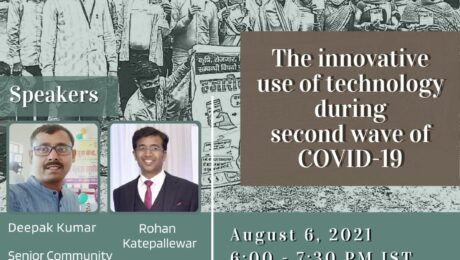
| Innovative use of Technology during the Second Wave of Covid-19! Join the new Vikalp Varta 2.0 with Rohan Katepallewar, manager at Gram Vaani and Deepak Kumar, Senior Community Manager at Gram Vaani who share how they used technology to tackle Covid-19 in India! Date: Friday, 6th August 2021 Time: 6:00 – 7:30pm IST Zoom Link: https://bit.ly/VikalpVartaP202 (No Registration Required) About Gram Vaani Gram Vaani started in 2009 is a social tech company incubated out of IIT-Delhi. They use technology to create participatory media platforms that people find accessible and adaptable. Using simple technologies and social context to design tools, they have been able to impact communities- more than 3 million lives touched through 25+ district and partner platforms covering 20+ Indian states. Their platforms have also covered 5 countries beyond India – Ethiopia, Afghanistan, Pakistan, Namibia, South Africa. Brief note on Vikalp Varta – During the second wave of Covid Pandemic, Gram Vaani addressed a host of problems to tackle the crisis. They made efforts in 5 areas – Addressed the stigma and fear around covid through their Interactive Voice Response (IVR) lines and teleconsultation – Addressing the lack of awareness and covid appropriate behaviour through developing audio content in multiple languages based on technical advisories – Facilitating emergency support such as cash, transportation, ambulances, oxygen, etc. to people requesting help on their platform especially to those who do not have social security mechanisms – Deploying voice-based survey tools & registration systems for supporting vaccine registration, especially for those, who were unable to use smartphones or access the online vaccine registration systems themselves Envisioning an IVR system for monitoring and triaging of patients under home-care, to escalate in time any at-risk cases. |
- Published in Announcements
Webinar: “Salween Peace Park, Myanmar: Strengthening Karen People’s Resistance, Resilience and Response to Conflict and Covid-19 Crises”
| Alternatives in Pandemic Times: Resistance, Recovery and Re-Existence – a Webinar series Salween Peace Park, Myanmar: Strengthening Karen People’s Resistance, Resilience and Response to Conflict and Covid-19 Crises with Saw Paul Sein Twa and Naw Wah Ku Shee Sunday 1st August – 14:00 (UTC/GMT) The Salween Peace Park is an initiative in Myanmar declared by Indigenous Karen people in December 2018 to bring peace, cultural harmony, self determination, and environmental integrity after 70 years of armed conflict in the region. However, the community continues to face threats from the Burmese military dictatorship. In this webinar, Saw Paul Sein Twa and Naw Wah Ku Shee talk about the experience of the Karen people working towards self determination, navigating a global pandemic, and facing a violent military offensive. More information and registration Direct access to the session About the presenters Saw Paul Sein Twa Paul is an indigenous Karen from Burma/Myanmar, co-founder and Director of the Karen Environmental and Social Action Network (KESAN)— a non-profit NGO, Member of the ICCA Consortium, dedicated to livelihood security and respect for the Indigenous Karen people in Burma/ Myanmar. Paul has worked for decades to better the conditions of his people, most recently as one of the main inspirers and key supporters of the self-proclamation of the Salween Peace Park by its custodian communities. The Salween Peace Park (SPP) is an emblematic territory of life of enormous importance for both nature and culture. It protects the last dam-free main river in Asia and 5,485 km2 of globally significant biodiversity. In 2020, the Salween Peace Park was awarded the Equator Prize. Naw Wah Ku Shee Naw Wah Ku Shee is a prominent Karen activist working to promote human rights, democracy and peace, with a focus on women and ethnic communities especially in conflict areas of Burma/Myanmar. She is currently director at Karen Peace Support Network (KPSN), the largest network of Karen community-based organisations. She is also a member of the Karen Women’s Organisation’s Steering Committee, with a membership of over 60,000, working to empower women in the struggle for peace and gender equality and for a federal democratic Burma. Our past webinar sessions videos are available in this link. Global Tapestry of Alternatives [email protected] To subscribe and get our updates, visit this link |
- Published in Announcements
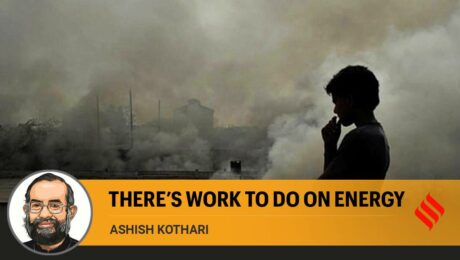
India must show global leadership on climate crisis by adopting a holistic approach to energy
Access this article in Hindi
Ashish Kothari writes: It must re-examine the unsustainable and inequitable ways in which power is
produced and distributed.
In classic double-speak, political leaders of Western nations express alarm and make promises about the climate crisis, but do precious little to tackle it. India is not far behind. The latest avatars of climate greenwash are both corporate and governmental: Asia’s richest man Mukesh Ambani’s has announced Rs 75,000-crore
of investment in clean energy and the India-US Climate and Clean Energy Agenda 2030 Partnership was launched at the Leaders’ Summit on Climate called by US President Joe Biden.
According to the partnership statement: “The United States has set an economy- wide target of reducing its net greenhouse gas emissions by 50-52 percent below
2005 levels in 2030 …. India has set a target of installing 450 GW of renewable energy by 2030 … The partnership will aim to mobilise finance and speed clean energy deployment; demonstrate and scale innovative clean technologies needed to decarbonise sectors including industry, transportation, power, and buildings; and build capacity to measure, manage, and adapt to the risks of climate-related impacts.”
Sounds great. But Biden’s promise, while certainly a welcome change compared to President Trump’s climate denialism, falls far short of what is needed. G7 countries are also announcing “net zero carbon” targets which hide the continued reliance on destructive technologies in the pursuit of ever-increasing energy generation. The historical responsibility of industrialised countries in creating the crisis continues to be avoided.
But what about the Indian government and corporate sector that claim to be global climate leaders? The rapid increase in renewable energy (RE) capacity and partnerships like the International Solar Alliance have won appreciation. But this hides four crucial flaws.
First, while substantially increasing RE, India is also expanding fossil fuel extraction and use. In the middle of the pandemic, the government has auctioned 60 new coal mining blocks, and several new thermal power stations are being considered. This includes mining in some of the most biodiverse forests in Central India. In effect, total carbon emissions, which is what impacts climate, will keep going up even as RE’s share rises.
The decarbonising of sectors mentioned in the statement could certainly reduce emissions. But without any targets, is the government serious? For instance, while public transportation has been given more investment in the 2021 budget, there is no discouragement of private cars, and fossil fuel use continues to rise. Yet, it is one part of the partnership that could yield benefits, if intense civil society pressure could force appropriate action.
Second, India includes mega-hydropower in RE, despite the ecological and social havoc it causes. Has the recent flood tragedy in Uttarakhand led to any reconsideration of these plans?
Third, even RE production is mostly of the mega-park type. In late 2020, the Ministry of New and Renewable Energy (MNRE) said that 10,000 sq km in seven states are available for such parks. These projects have serious ecological and social impacts but do not even need an environmental impact assessment, under the faulty assumption that RE is necessarily “clean” and eco-friendly. About 60,000 hectares of Kachchh’s ecologically fragile grassland-desert ecosystem have been allotted to energy mega-parks. The government’s target of 100 GW by 2022 also included 40 GW of rooftop solar, but poor policy back-up has stymied it.
Fourth, it seems that any amount of electricity demand is legitimate, to be met in all possible ways (including dangerous nuclear power). But this is simply unsustainable, whatever the source of energy. A shift from petrol-diesel to electric cars, for instance, would significantly expand devastating mining across the world. This is also a consequence of thinking of climate and ecological crises only from a carbon perspective, ignoring biodiversity loss and pollution. Unless luxury and wasteful consumption is eliminated, unsustainability and people’s displacement are
inevitable.
Such an approach also undermines democracy. People who protest the forcible acquisition of their lands for mega-projects are labeled anti-development — even anti-national. The unequal colonial relationship between the North and the South is replicated in internal colonisation when the government grabs land, forests, and water, converts relatively self-reliant communities into cheap labour and does little to help them adapt to climate crisis impacts.
Viable alternatives have been demonstrated across the world. The Delhi government is supporting 150 government schools to generate rooftop solar energy, helping them save Rs 8.8 crore on electricity and earn Rs 8.5 crore from selling power back to the grid. A study in the US shows that rooftop solar can create 30 times more jobs than mega-solar parks. Integrated power micro-grids can provide adequate power for entire villages and urban neighbourhoods, and be locally managed.
Alternatives to energy-guzzling sectors like urban construction and privatised transportation exist. Groups like SECMOL in Ladakh and Hunnarshala in Kachchh have shown how sensitive architecture can dramatically reduce electricity use. Most important is demand regulation.
Consumer behaviour that uses wasteful and luxury power can be changed and regulated, and power redistributed to those who do not have enough. All this should be part of the National Energy Policy. People’s mobilisation will be crucial to make all this happen.
While we all have a right to the energy we need for well-being, we cannot keep demanding more and more, nor can we allow the unsustainable and inequitable ways in which it is produced and distributed. Without us sustaining the earth, the planet will not sustain us. In this, India needs to show global leadership.
This column first appeared in the print edition on July 8, 2021 under the title ‘There’s work to do on energy’. The writer is with Kalpavriksh, Pune. Views are personal.
To download the article, please click here.
- Published in Latest Post
Pastoral Communities’ Territories of Life in Asia; Tales of Coexistence of Nature and People
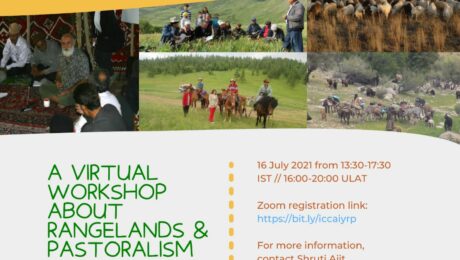
| Virtual workshop about Rangelands and Pastoralism in Asia Rangelands and pastoralism are essential for millions of people around the world, providing or contributing to livelihoods, food security, and cultural identity. Around half of the Earth’s land surface is rangeland. As rangelands are often among the harshest of environments, many pastoral communities have adopted a seasonal migration lifestyle in their ancestral territories in order to increase their resilience to natural challenges and simultaneously to sustain natural resources. As the late Dr Taghi Farvar regularly noted, “the migratory practices of indigenous peoples are almost always de facto nature conservation strategies”.To acknowledge the vital roles of rangelands and pastoralism for human wellbeing and nature conservation and to support and bring greater recognition to the upcoming International Year of Rangelands and Pastoralists (IYRP) in 2026, a virtual workshop is scheduled for July 16, 2021, on Pastoral Communities’ Territories of Life in grasslands/rangelands across Eurasia.The workshop is co-hosted by the ICCA Consortium, the ICCA-GSI, GEF SGP (UNDP), and collaboration of Regional IYRP Support Groups (RISGs) for the IYRP 2026: East Asia, South Asia, Middle East, and Central Asia & Mongolia. The high-level objectives of this inaugural special event are to establish an Asia-wide Learning Network on rangelands and pastoralism, particularly in relation to local and indigenous pastoral communities’ Territories of Life, and to promote the IYRP 2026.The specific objectives of this one-day special event are the following: To share experiences (best practices, key challenges) on rangelands and pastoral communities’ territories of life/ ICCAs from across Asia To declare support for the International Year of Rangelands and Pastoralism (IYRP) To determine key topics, format, and timing for follow-up events and other actions To commemorate the life, work and vision of Dr M. Taghi Farvar During this event participants will contribute toward the planning of a series of workshops in Asia to further advance the above objectives and enhance enabling environments that promote and strengthen the role of territories of life / ICCAs in the conservation of nature at various levels.Dr M. Taghi Farvar (1942-2018) was a pioneer in bringing to light the collective conservation capacities of indigenous peoples and local communities. Throughout his life, he defended their collective rights over their territories, and sought to influence relevant policies at national and international levels. An account of Dr Farvar’s life and achievements is available at https://www.iccaconsortium.org/wp-content/uploads/2018/07/Mohammad-Taghi-FARVAR-24-July-2018-1.pdf The workshop will be held on July 16, 2021 from 16:00-20:00 ULAT (check local times here). The workshop will be held on Zoom. To register, please follow this link: https://bit.ly/iccaiyrpThe deadline for the registration is 15 July 2021. For any queries, please write to [email protected] |
- Published in Announcements
Confronting COVID 19 with dignity and strength: Resilience of small-scale fisheries in Costa Rica
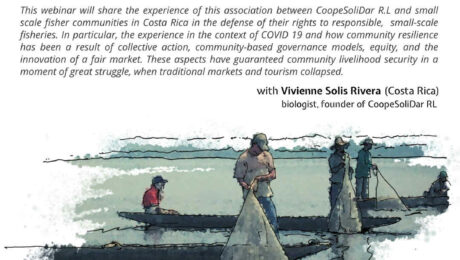
| Alternatives in Pandemic Times: Resistance, Recovery and Re-Existence – a Webinar series Confronting COVID 19 with dignity and strength: Resilience of small-scale fisheries in Costa Rica with Vivienne Solis Rivera (Costa Rica) and Nalini Nayak (India) Friday 2nd July – 3:00 PM (UTC/GMT) This webinar will share the experience of the association between CoopeSoliDar R.L and small scale fisher communities in Costa Rica in the defense of their rights to responsible, small-scale fisheries. In particular, the experience in the context of COVID 19 and how community resilience has been a result of collective action, community-based governance models, equity, and the innovation of a fair market. These aspects have guaranteed community livelihood security in a moment of great struggle, when traditional markets and tourism collapsed. More information and registration Direct access to the session About the presenter Vivienne Solis Rivera Is a Costa Rican biologist with a MSc. degree in Ecology from the University of Lawrence in Kansas. She has devoted her professional life to the support and recognition of the efforts of IPLC to conservation and sustainable use in the Central American region. She is the founder of CoopeSoliDar R.L. About the moderator Nalini Nayak is an activist, feminist and trade unionist based in Kerala, India. She has been involved with coastal communities and their issues for over three decades, associated with Protsahan Trivandrum, Mitraniketan Vagamon and the Self Employed Women’s Association. From SEWA Kerala and International Collective in Support of Fishworkers, she will moderate the session. |
- Published in Announcements
Latest Protected Area Update Newsletter, June 2021, No. 151

- Published in Latest Post
Good news! Our Children’s Book ‘The Miracle on Sunderbaag Street’ shortlisted for the Neev Book Award!

Happy to share the news that one of our books has been shortlisted for the Neev Book Award…The Miracle on Sunderbaag Street by Nandita da Cunha and illustrated by Priya Kuriyan (Emerging Readers Category)! To read the book access Our Store #NeevLiteratureFestival #NeevBookAward2021 #BookWeLove #LoveToReadToLove #IndianLiterature #Literature #LitFest #ChildrensLiterature #ChildrensBooks |
- Published in Announcements
Vikalp Varta 2 Dialogue Series: Tribal Health Initiative and Kunariya Panchayat
Dear All,
We welcome you to join us in restarting the series – Vikalp Varta: Dialogues on Covid Action.
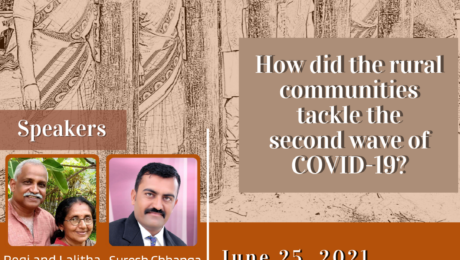
The first webinar of the series is ‘How did the Rural Communities Tackle Covid-19?’
In this webinar, we have invited Regi and Lalitha of Tribal Health Initiative, and Suresh Chhanga of Kunariya Panchayat, to share their experience of tackling the second wave of Covid-19 in Sittilingi, Tamil Nadu, and Kutch, Gujarat respectively
Date: 25th June 2021 Time: 7:00 – 8:30 pm IST Registration Link: https://bit.ly/VikalpVartaP201
This webinar will be available on Zoom and Vikalp Sangam’s Youtube Live (on the day of the event.)
If you would like to watch how they fared during the first wave of COVID-19, please find below the webinar recording for the series of Vikalp Vartas with the Tribal health initiative and Kunariya panchayat.
Vikalp Vārtā # 18 -Weaving together health care, food, farming, craft, education and self-governanceRegi and Lalitha from Tribal Health Initiative Madheswari, Panchayat President.Watch here: https://www.youtube.com/watch?v=lAtLNbgAsJc
Vikalp Vārtā #6 – Panchayat’s Response through Self-Governance and Inter-generational LearningSuresh Chhanga (Sarpanch, Kunariya village, Kachcch) along with members of village COVID-response teamWatch here:https://www.youtube.com/watch?v=tb9HC37FAtA&list=PLVGJfYVd8JMXoo4JE-0JNBoQk2fzxL9vK&index=14
- Published in Announcements