
Keeping crawlies for green company

Generations of humans rise and fall within the lifetime of one tree, and yet we have managed to shake its very foundation with our irresponsible and careless lifestyle.
TO READ MORE CLICK HERE.
- Published in Latest Post
Suburban Tales! How Love For A Bandra Garden Inspired A Book
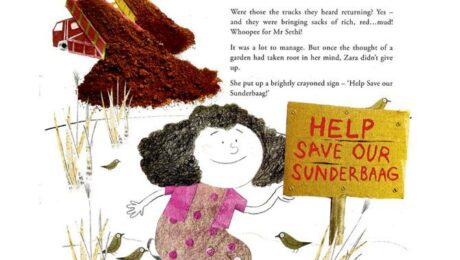
D’Monte Park Street’s resident-run Dream Grove project has inspired a children’s book. And we love it
TO READ MORE CLICK HERE.
- Published in Latest Post
Press Release: Urgent Need to Support Goba System of Ladakh
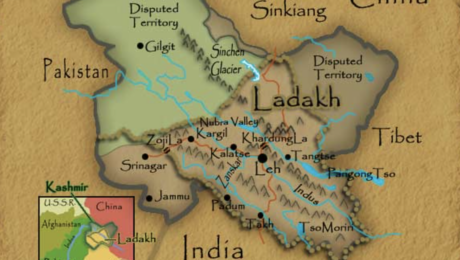
Five civil society organisations are encouraging the UT Administration and the Hill
Council, along with Ladakhi society, to recognise and strengthen the goba (or
nambardar) system.
In a detailed study led by Kalpavriksh (a Pune-based organisation active in Ladakh), in
coordination with Ladakhi organisations Snow Leopard Conservancy – India Trust (SLC-IT),
Nature Conservation Foundation (NCF), Ladakh Media and Arts Organisation (LAMO), and
Local Futures, it was found that the goba system is still highly relevant for Ladakhi society.
Across the Leh district, people continue to have faith in this system, and insist that it should
continue along with the Panchayat system.
TO READ MORE CLICK HERE.
- Published in Latest Post
Webinar #13: “Self-determination & coping with COVID19 in indigenous Lomerio, Bolivia”

| Global Tapestry of Alternatives and Global Dialogue for Systemic Change present: Dialogue on Alternatives in the Time of Global Crises – a Webinar series Dialogue 13: Self-determination & coping with COVID19 in indigenous Lomerio, Boliviawith Elmar Masay and Maria Chore, Monkoxi leaders, Bolivia Friday 23th October – 1:30 PM (UTC/GMT) 7pm IST Monkoxi leaders from the Indigenous territory of Lomerio, Bolivia, will share experiences dealing with COVID-19. Though the pandemic led to 20 people dying, the Monkoxi were able to control further spread by blocking access in and out of their territories, coordinating with partners the delivery of biomedical equipment, and (esp. important) reviving traditional medicine and community care values and relations. Participatory indigenous research in collaboration with Nur University (Bolivia) and University of East Anglia (UK) is helping systematize this learning, for possible similar out-breaks in future, and to share with other indigenous nations. This builds on several years of process to claim self-determination rights to the territory. Information and registrationDirect access to the session About the presenters Elmar Masay Soquere Elmar Masay Soquere is Chief of the Monkoxi Indigenous Nation of Lomerio, Bolivia, located in the Chiquitano Dry Forest, the last best conserved dry tropical forest in the world. The Monkoxi were the first indigenous nation in Bolivia to self-proclaim themselves autonomous and the first case of forest certification in the country through the Forest Stewardship Council. They are about to become one of the first lowland Indigenous peoples to be recognized as autonomous under the country’s recent autonomy law and 2009 Constitution. From 2000 to 2001 Masay worked as a computer specialist for the Indigenous Center for the Original Peoples of Lomerio (CICOL). Between 2002 and 2009 he served as a technical advisor on the Indigenous Territorial Management Committee in the Native Communal Territory of Monteverde, focusing on sustainable development and natural resource management with the goal of gaining legal autonomy with a territorial base for 128 communities. He also participated in the Indigenous marches for sovereignty and Indigenous rights as well as to advocate for a Constituent Assembly to draft the 2009 Constitution. From 2010 to 2012 Masay provided technical support for the Lomerio Native Communal Territory in the process and legal claim for Indigenous Autonomy on behalf of the 29 communities located in the territory. Between 2013 and 2017 he was elected as chief of economy and production in CICOL. Subsequently, the communities decided to elect him as General Chief of CICOL, which is the maximum authority within the Monkoxi Nation in Lomerio territory. Maria Chore Maria Chore is a woman indigenous leader from Lomerio. As Chief of Autonomy in CICOL, she has played a central role mobilizing and foreseeing the claim for political autonomy before the Bolivian State. She has also been chief of Gender issues in CICOL and has worked as indigenous researcher in various projects related to the reconstruction of the Monkox indigenous identity. Our past webinar sessions videos are available in this link. |
| Global Tapestry of Alternatives[email protected]To subscribe and get our updates, visit this link |
- Published in Announcements
Video: Gandhi Lives! Perspectives on Satyagraha, Swaraj and Self-reliance
Mahatma Gandhi’s ideas, ideals, and life are as relevant today as ever, to deal with the horrific inequalities, ecological devastation, and injustice across the world. Satyagraha can help us speak truth to power, swaraj to reclaim power inherent in each of us, and self-reliance to rid ourselves of debilitating dependence on govts and corporations. A presentation to Dept of Social Work, Delhi University, 30.9.2020
- Published in Latest Post
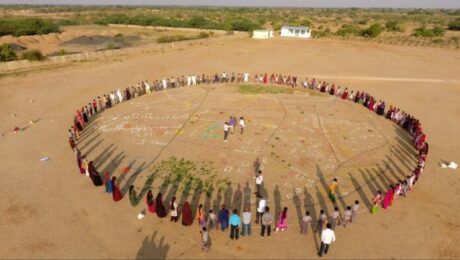
Mahatma Gandhi calls PM Modi: “Did you really mean Self-reliance?”
- Published in Latest Post
No Atma, Lots of Nirbharta: The Socio-Ecological Bankruptcy of Modi’s Self-Reliance Stimulus
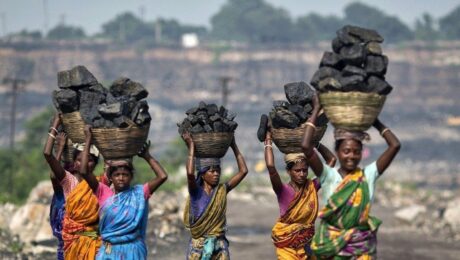
The most blatant example of ecological illiteracy in the name of ‘self-reliance’ is that of coal mining – a sector which is being opened up in parts of central India which were hitherto off-limits.
To read the entire article, please click here.
- Published in Latest Post
Video: Eco India: How Gandhi’s idea of Swaraj is inspiring communities to take charge of their environment?
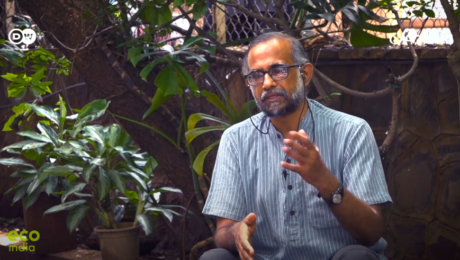
For long, India has mirrored the top-down development approach of the West. In this special interview, environmentalist and thinker Ashish Kothari talks about why that needs to radically change through imbibing the ideas of ‘Eco Swaraj’ – a common theme among many grassroots environmental movements in the country that are re-defining their relationship with the environment. “You build in the notion of Swaraj, which is a deeply political and economic concept of independence and autonomy, but also a responsibility to the rest of nature,” says Kothari.
- Published in Latest Post
Launching an interactive map on Conservation Conflicts in India
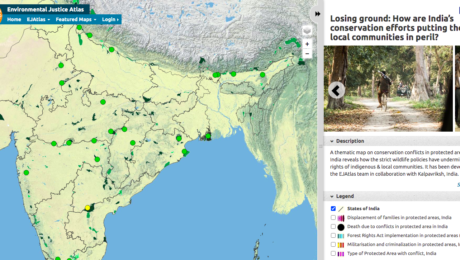
On the occasion of #WildlifeWeek the #EJAtlasteam and Kalpavriksh are launching an interactive map on Conservation Conflicts in India, which reveals the impacts of this fortress-like conservation model in India. This new map documents the violations of Wildlife laws in Protected Areas and shows the struggles of local and Indigenous communities opposing policies that exclude them from the current management of natural resources. The map reveals lack of regard for the self-determination of the communities by the government authorities.#ConflictsPAIndia
- Published in Announcements
CCA South Asia Webinar Series #3: Van Panchayats, Uttarakhand (22nd September, 5pm IST)
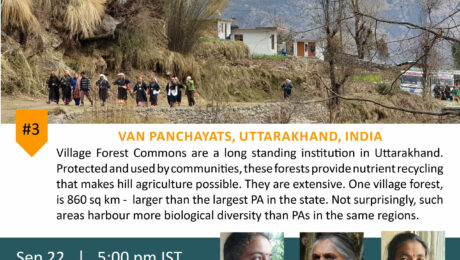
About the Talk
Village Forest Commons are a long-standing institution in Uttarakhand that pre-dates the current format of the Van Panchayats yielded by the colonial British after their regional appropriation of all lands. Like true commons, these forest and rangeland commons have been protected and used by village communities primarily to meet their subsistence needs of fuelwood, fodder and small timber as also providing the critical nutrient cycling of compost that makes hill agriculture possible at all. Though currently facing a slew of incremental measures to control and commercialize these forests they remain, wherever communities are still dependent on agriculture and pastoralism, their live support base. In such area, especially at higher altitudes village forests and rangelands are extensive, constituting over 60% of the landscape in the Gori river basin. One village forest, for instance, covers about 860 sq km, larger than the largest protected area in the state. Not surprisingly, such areas harbour wildlife and biological diversity comparable to Protected Areas in the same geographical zones.
Join us as the speakers discuss the persisting relevance of Van Panchayat in the face of the larger dismantling of Commons worldwide, the continued dependence of poorer households for their livelihoods, rapidly dwindling biological diversity everywhere and the critical the need for forests and wild spaces in the cultural and economic context.
Malika Virdi is her second term as Sarpanch, the elected head of the Sarmoli- Jainti Van Panchayat.
Rekha Rautela is a panch (elected representative) of Sarmoli Van Panchayat
Beena Nitwal is a panch (elected representative) of Sankhdhura Van Panchayat
To join the webinar: https://us02web.zoom.us/j/82247993867
View the previous webinars:
For any query or to sign up to the CCA South Asia e-list, please write to [email protected]
- Published in Announcements